From 1954 to today, more than thirty-nine thousand Braccialini handbag designs have been created—born from the creativity of Carla Braccialini and her team of designers. The Braccialini brand was founded in Florence, the historic heart of traditional Italian leather craftsmanship. Many major fashion houses produce their bags in the Arno Valley: as early as the 12th century, hides were soaked along the river before tanning, then turned into pouches for pilgrims and saddlebags for merchants.

Carla Cecconi-Braccialini

Carla Cecconi-Braccialini wins first prize for best drawing at the “1st Youth Art Exhibition”, Florence, 1941.
Braccialini began as a workshop: the practical expression of a young artist’s unbridled imagination. And the very first material was straw. Carla transformed classic shapes into unexpected, surprising objects. In the 1950s, women’s handbags all looked much the same, but Carla Braccialini—like so many other women—was tired of the limited choice on the market, of the usual rotation of “brown and black bags for winter, and white, blue, or beige for spring—always leather, very structured—and the straw basket for summer by the sea.” No one had yet tried to offer a light, playful alternative. She did—because she loved to draw, and because she was looking for work that could give her a reason to live.

1954: Basket bag made with knitted satin ribbons in graduated shades. Grosgrain handle trims and bow.
“We started selling crochet dresses and accessories made by a relative of ours, who coordinated a working group—a small network of women employed from home… We filled a suitcase with a sample set of thirty-five pieces, including dresses and little hats, and went to sell them in Liguria, which at the time was the chicest seaside coast.” The results were good, even though Carla Braccialini still didn’t know how to construct a handbag.
At the time, Braccialini wasn’t yet a brand, and the couple didn’t even have a workshop—only an office on Via delle Pinzochere. Soon after, the young newlyweds Carla and Roberto Braccialini opened a small workshop: “my husband handled the commercial side, I did the creative work, and we had five skilled workers.” The first little bags, classic in shape, were made of colored straw and finished in contrasting leather and lace.

During a photo shoot on the steps of San Miniato al Monte, Florence, 1973.
It was a success, but Carla Braccialini didn’t stop at the first step. She began experimenting with embroidery on leather. In 1965 there were still no machines capable of this kind of work: “There were some punch-card machines suitable for fabric, but on leather they would cut through it irreparably.” Carla, however, found a craftswoman with a machine that could sew in a zigzag stitch: it was the right solution, and she adopted it immediately to join “thin strips of leather in different colors, in gradation,” creating “striking patterns” that—once again—became an entirely new kind of bag.

A 1973 model in calfskin with leather lacing.
The decade between 1966 and 1976 was the hardest in the history of the Braccialini family. First came the flood of Florence, when “the water rose two meters above the workshop ceiling, which was in a basement on the Lungarno”; then the death of Roberto Braccialini. Supporting Carla were Piero Balloni—a talented pattern maker who joined the company right after the flood—and her two eldest sons, Riccardo and Massimo, who both learned to cut and sew prototypes under the orders of “this gruff artisan with a direct gaze,” trying to earn his respect.

The sketchbook, found after the 1966 Florence flood.

Photo shoot, 1973, Piazzale Michelangelo, Florence.

From the 1978 photo book.

Advertising spread in “Ars Sutoria” magazine, winter 1975. Many small squares of glossy and suede kid leather, hand-assembled and joined with zigzag stitching.
The 1980s—with complex shapes and an abundance of details and techniques—were a period Carla Braccialini felt especially close to: patchwork, gold-coated inlays, layered materials and colors, embossing, contrasting ribs. “There were no limits, and we experimented with everything.” The designs were large and soft, with drawstring closures, or small and sinuous, adorned with tassels, to be worn on long shoulder straps over evening dresses.

In the sample room of the old factory on Via Pio Rayna in Coverciano, 1984.

Calf hair-effect bags with kid-leather trims and handles; accessories and zippers in gilded metal / White kid-leather bag with fringes.
From the early 21st century onward, after moving beyond a stylistic lull that—by reaction—rekindled a desire for eccentricity, nonconformity, and distinction, the element of surprise that an ever-growing Braccialini audience expects has often been linked to the Themes: a special line of unique designs that, season after season, pushed Carla Braccialini into long experiments in choosing and pairing leathers and techniques. “Each time, it’s almost impossible for me to imagine which model the market will prefer.” It’s the one big surprise that still awaits her.

In April 2014, Carla Braccialini celebrated 60 years of activity at the Marino Marini Museum in Florence, with an exhibition of her best bags titled “The Enchanted Garden”.


Braccialini exhibition “The Enchanted Garden” – Marino Marini Museum
In 2017 the Braccialini company was acquired by Tuscany-based Graziella Holding, a jewelry business.
In 2021 Graziella Braccialini introduced the new “Jewelry and Fashion” project, through a high-end line of bags paired with costume jewelry and precious stones. The company continues to preserve Carla Braccialini’s unique style, which has by now become an important chapter in the history of 20th-century fashion.
Carla Braccialini’s inspirations: the culture of beauty, wherever it may be found.
Being born in Florence is a privilege: it means growing up breathing in the light, the atmosphere, and the colors of some of the most important works of art in the world.

Clio bag, created in 2009. An iconic design built around a zipper, with multiple pockets and a large metal clasp.

Tribal inspirations
Bags: TEMI.
Since 2003, every season, the Braccialini company has created new “sculpture bags” called TEMI. Some Themes—the car bag, the clown bag, the crown bag—have become synonymous with the brand, the “pieces” many people name spontaneously, as also shown by a market survey carried out toward the end of the last decade. Braccialini is synonymous with imagination, and the Themes are its most complete expression.
The Themes are an art collection: one-of-a-kind pieces, handcrafted jewels that are only seemingly playful. As Carla Braccialini explains: “It often takes two or three months to create a prototype.” Each bag in the TEMI line is handmade and built “on a form,” a method that presupposes—and requires—the highest level of craftsmanship: each model is made from fifty or a hundred basic components (excluding metal hardware) and, often—as in the case of a 2014 model (the Chameleon bag)—researching materials in the right color shades and finishes involves extremely long lead times and constant collaboration with workshops and leather specialists.

As for the origin of the first Theme, Carla Braccialini’s story has become legend—part of the family vocabulary. La Casina, a small trunk bag in different leathers, with inlays, appliqués, and embroidery, a red nubuck roof, a rounded double door, climbing vines, and sangallo curtains at the windows, was born after an evening mugging on Via Tornabuoni, in her Florence: “I felt lost, as if they had taken my home away from me—it was a violent shock,” she says.

The next morning, “as if in a kind of revelation,” the design of this cathartic bag flowed from her pen—the founding piece of a cult line for a devoted audience. She says she never expected it would achieve such success: she displayed it at MIPEL (the trade fair held every February and September in Milan) almost exclusively as a decorative element for the stand. And yet, year after year, the La Casina bag continues to be requested alongside new models, and online it is traded and auctioned among enthusiasts.

Clown bag, 2006, shown from both sides.

Marine Themes. Cabin, summer 2010; Fish, summer 2006; Ship, summer 2004; Parrot, summer 2004.
Postcard Bags – a message you can carry.
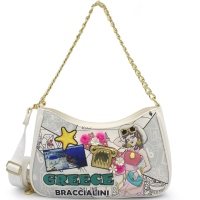
A souvenir, a keepsake, or the desire for a future journey. From the Tua by Braccialini line, developed starting in 1990 and aimed at a younger audience, the Postcards collection was born. Landscapes, stories, and impressions from the most beautiful cities in Italy and around the world; familiar places or magical, far-away ones; bags built through layers of different materials. The first, conceived in the flow of a creative thought, depicted “a female silhouette and a landscape in which many thought they recognized Capri,” Carla Braccialini recalls.

Since then, around those stories and the embroidered invitation on the back—the classic “greetings from…”—the Taormina, Florence, Venice, and Rome bags were born. Physical, geographical places, but also emotional and imagined ones. Each season the story, the destination, and the feeling change.

The first series of Postcard Bags dedicated to Italian cities, Spring–Summer 2005.

The Journey; Fairy Tales; Countries of the World; Lovers.
And perhaps that is Braccialini’s secret: always surprising, without ever losing its Florentine roots. In every bag there is an idea, a spark of imagination, a detail that can make you smile—and stay with you. Discovering its creations means choosing an accessory that speaks to you, to the way you see the world and live your style. Because some bags aren’t just worn: they’re carried like a small everyday story, made of character, emotion, and beauty.

 +39
+39 info@air-fashion.com
 Enter
Enter